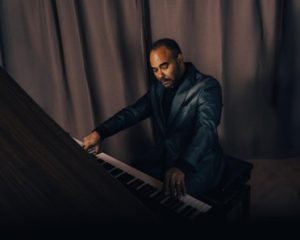
Manuel Peguero’s new piano solo album, “Dark Piano Contemplations,” arrives with the assurance of an artist who has taken his time developing his voice. The New Jersey–based maestro has been open about beginning later than most, yet his playing now carries the clarity of someone who has spent years pushing himself through Chopin, studying Rachmaninoff’s darker colors, and embracing the expressive sweep of composers like Ernesto Lecuona. Those influences appear throughout this album, not as decoration but as part of the way Peguero organizes emotion at the keyboard.
The central idea behind “Dark Piano Contemplations” is the quiet preparation for a new chapter in life—those thoughts people revisit when they’re deciding how to move forward. That theme takes shape most clearly in the tracks like “Triumph Is Near.” Lasting just over two and a half minutes, it has a determined pulse that feels almost like a steady inhale before action. Peguero keeps the left hand grounded while the right hand threads a line that rises with purpose. It moves with a firm stride—measured, aware, and confident enough not to shout. You can hear a bit of his fondness for expressive Romantic phrasing, but the overall feeling is contemporary and understated, almost like he’s guiding the listener through a moment of personal resolve.
If “Triumph Is Near” is the breath before movement, “The Fog”—sits firmly inside the uncertainty that comes before clarity. This is where Peguero’s instinct for shadowed harmony shines. The piece leans into soft, low-voiced chords that hover without losing shape, creating a quiet tension that feels familiar. The melody doesn’t wander. Instead, it circles gently, keeping close to the emotional center. Nothing escapes the mood, yet it never sinks into heaviness. It has the stillness of early morning – muted, cautious, but undeniably alive. Even without lyrics, the track communicates an internal whispering where doubts and hopes share the same space.
“A Man Finds His Own Path” has more movement than the other two, not fast, but with a steady unfolding that mirrors the process of someone beginning to trust their own decisions. There’s a sense of searching in the way the motifs return and evolve, as though Peguero was sketching the shape of a person’s journey in real time. The pacing is patient, and the dynamics stay controlled, giving the piece a reflective quality without slipping into sentimentality. It’s the work of a composer who understands when to hold back and when to let a line open just enough to show where the story is headed.
Around these originals, Peguero places film-score transcriptions like “Chess Match,” “Dining with Lecter,” and “Dressed to Kill (The Museum).” They match the album’s atmosphere well, partly because he chose pieces that already carry mystery in their DNA. But the deeper success lies in the way he shifts them into solo piano. The themes lose none of their tension, yet the keyboard alone brings them closer to the listener, more like private reflections than scenes from a movie. This choice also reinforces one of the album’s major ideas – concealed intention. These are themes that fit the mind of someone working out a plan quietly, without broadcasting it.
Among the additional originals, “Vigilance Before the Voyage” has already become a favorite among early listeners. While “Silent Defiance” and “Abscond to Freedom” lean deeper into Peguero’s expressive instincts, each one adding another angle to the album’s narrative of inner renewal.
The honesty of “Dark Piano Contemplations” is its strength. It doesn’t posture, but reflects a musician who has learned to trust subtlety. The pieces move with intention, shaped by years of steady practice and late-night reflection, and they speak in a tone that welcomes the listener into their own thoughts. Each track feels like a pause between chapters—not an ending, but a moment to gather focus.
With this release, Manuel Peguero adds another meaningful step to a growing body of work that includes “Dark Piano Liaison,” “Dark Piano Transcendence,” “Dark Piano Passions,” and this year’s “Dark Piano Mischievous,” “A Clever Scheme,” and “Man with a Harmonica.” His catalog keeps expanding, but “Dark Piano Contemplations” is especially close to the heart—a quiet cue that the turning points in life often begin in the moments when we finally let ourselves listen.
—-